
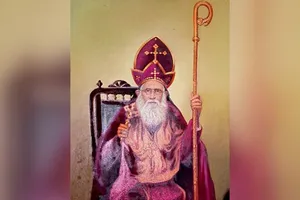
"For the perfecting of the saints, for the work of the ministry, for the edifying of the body of Christ" — Ephesians 4:12
Alvares Thirumeni had a firm faith in the Orthodox Church. Leaving his fortune in the Catholic Church, he embraced the Orthodox Church — and was excommunicated and persecuted for it. He was falsely accused, arrested, stripped of his Episcopal vestments, and taken through the streets to the police lockup. He was forcibly deprived of his cross and episcopal ring, beaten, and presented in court twice on false charges — acquitted both times. He was never again allowed to wear his Episcopal vestments; he wore only a black robe until his death. He suffered alone, forsaken, like his own Master, Jesus.
Early Life
Antonio Francisco Xavier Alvares (Alvares Mar Julius) was born on 29th April 1836 to a Goan Catholic family in Verna, Goa. He was ordained a priest of the Roman Catholic Church in Goa and appointed by the Archbishop of Goa to minister to Catholics in British India, in territories claimed by the Portuguese Crown under the ancient privilege of Padroado. When Rome re-organised the hierarchy in British India independently of Portugal, Fr. Alvares led a group of pro-Padroado Goan Catholics in Bombay — the Society for the Defense of the Royal Patronage — in agitating against the change.
Orthodox Church and Thirumeni
Still searching for the true Biblically Christian Church, and unable to accept the interference of civil power in Church administration, Alvares Thirumeni travelled through Western and Eastern Churches before finally joining the Malankara Orthodox Church. He was consecrated Bishop by Mar Joseph Dionysius (Pulikkottil), Geevarghese Mar Gregorios of Parumala, Mar Paulose Evanios of Kandanadu, and Mar Athanasios (Kadavil) at the Kottayam Old Seminary on 29th July 1889, and elevated to Metropolitan with jurisdiction over Goa (excluding Malabar) and Ceylon — the first bishop in the Orthodox Church to celebrate the Latin rite, and the founder of Latin-rite Orthodoxy. He lived in Colombo and Brahmavar-Calianpur, near Udupi on the Canara Coast, until 1913, when he moved to Goa.
Patriot and Saint
This title was given to Alvares Thirumeni by Goan historians. Excommunicated and persecuted by the Roman Catholic Church and the Portuguese Government, he refused offers to reunite with the Catholic Church even while gravely ill, remaining steadfast in his Orthodox faith. Based mainly in the Canara region of Karnataka, at Brahmavar, he worked alongside Fr. Noronha along the west coast of India from Mangalore to Bombay — about 5,000 families joined the Orthodox Church through their ministry, in what is today the Brahmavar Diocese.
Ordinations
Mar Alvares ordained two priests and a deacon for the Malankara Church, and in 1892 consecrated Joseph René Vilatte — an American priest titled Mar Timotheus — as Archbishop for the Church of the Mother of God in Wisconsin, with the consent of the Jacobite Patriarch H.H. Peter III.
Journalist, Educationist, and Social Worker
Thirumeni started several periodicals, including A Cruz (The Cross), Vardade (The Truth), O Progresso de Goa, O Brado Indiano, and Times of Goa — most banned by the government for their criticism of colonial rule. He opened a college teaching Portuguese, Latin, French, and Philosophy, and an English school in Panaji in 1912. During epidemics of malaria, typhoid, smallpox, cholera, and plague, he published public health booklets and campaigned for cheaper food production.
Apostle of Charity
Though the Portuguese Government dubbed him a traitor, Goans came to regard him as an "Apostle of Charity." In 1871 he founded a Charitable Association in Panaji to help the poor, later extending it across Goa. His home for the poor sheltered lepers, TB patients, scavengers, beggars, and other destitute people — and with no income of his own, he begged with a bowl in one hand and a staff in the other to support them.
Last Days and Funeral
His final days were spent at Ribandar Hospital, a charitable institution, where he suffered from dysentery. He died on 23rd September 1923, specifying that no Catholic priest officiate his burial. A citizen committee led by the Chief Justice arranged a grand funeral; his body lay in state at the Municipal Hall for 24 hours as thousands, especially the poor, paid their respects. He was laid to rest in a corner of the St. Inez, Panaji cemetery on 24th September 1923.